
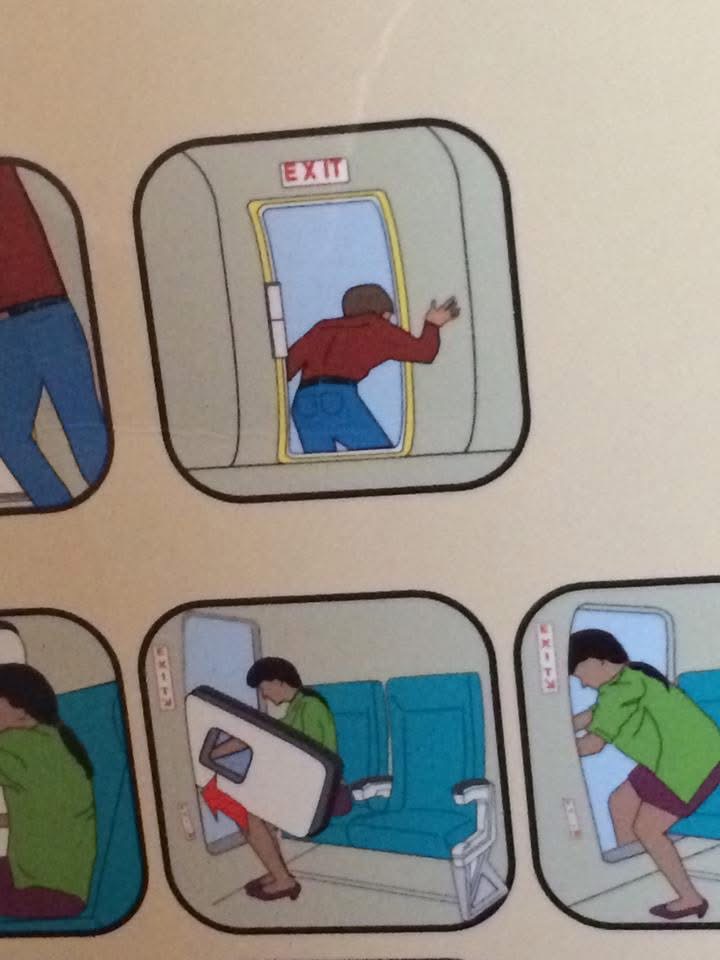
For years I have laughed at one particular airline safety-card illustration because it appears to show a woman not simply opening the emergency exit, but fully removing the door and taking it with her like she paid for it.
That is an amazing level of commitment. Most people in a crisis are just trying to remain calm and locate the nearest exit. This woman appears to have said, “I’m leaving, and frankly I’m taking part of the plane with me.”
Maybe I’m reading it wrong. Maybe the artist intended to show the door swinging outward. But that is not what the human eye receives. What the human eye receives is a passenger making a break for it with evidence.
Before we even get to the theft, though, I have some questions about the door.
Does it really come off that easily?
I had always assumed an airplane door was a fairly committed part of the airplane. Something installed by engineers. Bolts. Hydraulics. Possibly several meetings.
According to this drawing, one woman in sandals can pop it off like the battery cover on a television remote.
She isn’t even struggling. She has just removed a structural component of a commercial aircraft and is carrying it like a cafeteria tray.
Which raises another question: How sturdy was this door to begin with?
This is the thing separating us from 35,000 feet of atmosphere, and apparently it weighs about as much as a patio cushion.
Apparently the airplane is held together by a series of satisfying clicks.
The safety card is supposed to reassure me. Instead it has informed me that the airplane may be modular.
Do the wings come off?
Does the cockpit detach?
Is there a little plastic tab underneath the fuselage that says PUSH TO RELEASE?
Maybe that is the actual evacuation plan. Everybody takes one piece of the plane and eventually the emergency is over.
It also raises logistical questions. Are you required to bring the door? Is this part of the evacuation? Has the FAA been quietly expecting us to do some light carpentry under pressure?
If so, that seems like the sort of thing they should mention a little more clearly.
“In the event of an emergency, remain calm, help others if possible, and apparently remove one large section of the aircraft wall.”
But then I noticed something else.
She isn’t setting the door down.
She’s leaving with it.
That changes everything.
Perhaps this woman has discovered a loophole in American property law: during an emergency, nobody has time to stop you.
“Ma’am, you can’t take the hotel ice machine.”
“THERE’S A FIRE.”
“Right. Sorry. Keep moving.”
I now suspect this is not her first incident.
She has been banned from several escape rooms for misunderstanding the spirit of the activity.
She once evacuated a movie theater carrying an illuminated EXIT sign.
There is an Uber driver somewhere who still does not know what happened to his passenger-side headrest.
Police would probably describe her as a repeat offender specializing in the unauthorized removal of means of egress.
Most shoplifters take merchandise. This woman takes infrastructure.
I also appreciate the confidence of the drawing. There’s no hesitation. No panic. No uncertainty. She’s just hauling that door away like she’s leaving a Home Depot parking lot after making one impulsive purchase too many.
And where is she going with it?
Because eventually the emergency ends.
At some point this woman is standing on the tarmac while firefighters surround the aircraft and paramedics treat passengers.
Everyone else has a foil blanket.
She has a Boeing door.
And now the door is basically useless. She has taken the one object whose usefulness ended the exact second she successfully escaped through the space where it used to be.
This is like escaping prison and bringing the bars.
Does someone from the airline ask for it back?
Or does possession become nine-tenths of the fuselage?
The safety card itself provides no guidance.
Open the exit.
Remove the door.
Evacuate the aircraft.
There is no fourth illustration showing her loading it into the back of a Subaru.
I like to imagine she simply carries it through the terminal until she encounters the one force powerful enough to stop her: airline baggage policy.
“Ma’am, that will need to fit completely inside the personal-item sizer.”
“It fit on the flight here.”
“Was it attached to the aircraft at that time?”
Eventually, I assume, the door makes it home.
And suddenly her house begins to make sense.
The pantry has an AMC emergency exit.
The linen closet opens through a Greyhound bus hatch.
Her shed has the rear emergency door from a school bus.
There’s a hotel EXIT sign over the downstairs bathroom.
She doesn’t decorate. She decommissions.
Neighbors probably think she has an eclectic design sense. They do not realize they are standing inside twenty years of evacuation history.
Anyway, if I’m ever in an in-flight emergency, I hope I conduct myself with half the poise of the lady who, according to this diagram, successfully evacuated and improved her home at the same time.
And if she happens to be sitting in my exit row, I’m following her.
She may not know where we’re going.
But apparently she’s bringing the exit.