
Congressional Hearing to Condemn North Korea Ends With Both Parties Fighting Over Who Gets to Honor Kim Jong Un
Lawmakers stress that their opposition to unchecked power remains absolute when exercised by someone else.
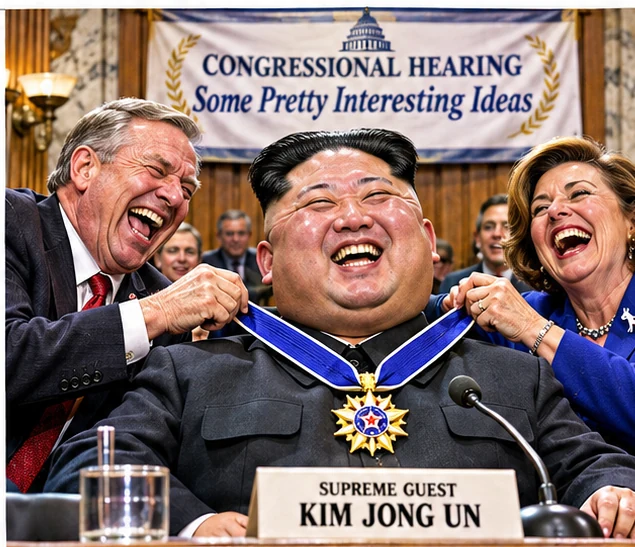
WASHINGTON, D.C. — A congressional hearing convened Tuesday to condemn North Korea’s dictatorship ended with Republicans and Democrats fighting over which party would present Kim Jong Un with the Presidential Medal of Freedom.
The hearing, originally titled The North Korean Threat to Democracy and Human Rights, was renamed Some Pretty Interesting Ideas approximately 37 minutes into testimony.
“We are here to confront a government where one man exercises unlimited authority, courts cannot interfere, and political opponents are powerless to stop him,” announced Republican chairman Richard Caldwell.
He paused.
“I’m sorry. The courts cannot interfere?”
“Correct,” replied the North Korean representative.
“Even some activist judge in California?”
“Even him.”
Caldwell removed his glasses.
“I don’t smoke. Is this what cigarettes are for?”
Democratic ranking member Patricia Wells objected.
“We cannot be seduced by authoritarianism simply because it offers administrative efficiencies,” she declared. “North Korea controls information, eliminates harmful speech, and requires commitment to collective social goals.”
She paused.
“Could you go back to eliminating harmful speech?”
The representative explained North Korea’s restrictions on public expression.
“That’s horrifying,” Wells replied. “But how effective is it at combating misinformation?”
“Extremely.”
“Do you have a PowerPoint?”
Staff requested North Korea’s censorship guidelines and a brochure titled So You’ve Identified an Obstacle.
Republicans were impressed by compulsory patriotism.
“Everyone stands for the national anthem?” Caldwell asked.
“Yes.”
“What if they don’t want to?”
“That is not considered relevant.”
“So participation is voluntary, but refusal isn’t.”
“Correct.”
“That’s the distinction we’ve been struggling to communicate.”
Wells objected that mandatory patriotism violated individual freedom.
The representative explained it was officially an opportunity to demonstrate community solidarity.
“Oh,” Wells said. “Well, that’s different.”
Both parties requested a list of people who declined the opportunity.
During the economic presentation, a slide appeared titled Equity Achieved.
“How do you know everyone is equal?” Wells asked.
“We conducted a study.”
“Who conducted it?”
“The government.”
“Who reviewed it?”
“Also the government.”
“That’s a conflict of interest.”
“We studied that too.”
“And?”
“No conflict.”
Wells requested the template.
“And you’ve eliminated economic inequality?” she asked.
“Almost entirely. Housing is uniformly inadequate. Food is uniformly scarce. Electricity is uniformly unavailable.”
Wells nodded.
“So no one is being left behind.”
“Correct. There is nowhere to go.”
Caldwell learned that senior officials enjoyed privileges unavailable to ordinary citizens.
“So everyone’s equal except the people running the government?”
“Correct.”
“Patricia, are you hearing this?”
“I’m sitting right here, Richard.”
“I know. I just don’t want us to miss this.”
The hearing briefly returned to its purpose when a freshman congressman asked what happened to North Koreans who criticized their government.
“They are dealt with,” the representative explained.
“Disgusting,” Caldwell said.
“Unacceptable,” Wells agreed.
“What if the criticism is true?” the freshman asked.
Caldwell questioned why he assumed the government was wrong. Wells cautioned against ignoring broader social context.
“What if people just want to be left alone?”
The room fell silent.
“Congressman, this is a serious hearing,” Caldwell said.
“What if they just want to watch television?”
“You’re describing a dangerous level of independence,” Wells replied.
“What if they don’t even like politics?”
Caldwell turned toward the representative.
“Do you have somewhere we can put this guy?”
The representative described political reeducation facilities.
“That’s appalling,” Wells said.
“Absolutely,” Caldwell agreed. “What’s the cost per person?”
“We are not discussing funding a reeducation facility,” Wells said. “We’re discussing whether an existing grant could cover it.”
The freshman’s microphone was disconnected.
The representative requested a copy of the committee rules.
“Which part do you oppose?” the representative asked.
“The North Korean part,” Caldwell said.
“Deeply,” Wells agreed.
“I was told this would be a human rights hearing.”
“It is,” Wells replied. “We’re discussing how to improve them.”
“Whose?”
“Let’s not get bogged down in specifics.”
The invitation to Kim Jong Un emerged as a demand for accountability.
“He should answer our questions,” Caldwell declared.
“Before a joint session of Congress,” Wells agreed.
“With appropriate security.”
“And a reception.”
“Nothing extravagant.”
“Obviously, there would be dinner.”
Republicans proposed a military parade.
Republicans offered Kim the Presidential Medal of Freedom.
Democrats proposed renaming Freedom itself in his honor.
Democrats insisted on community consultation.
“What if the community rejects it?” the representative asked.
“Then we’ll explain the consultation more clearly,” Wells said.
The representative asked whether he could leave.
“Not until we finish honoring you,” Caldwell snapped.
By midafternoon, lawmakers were discussing constitutional reform.
The representative explained that criticism of the Supreme Leader was forbidden.
“What about private criticism?” Caldwell asked.
“We discourage it.”
“Discourage?” Caldwell repeated, disappointed.
Wells leaned forward.
“Have you considered making people sign something?”
“Are you people trying to frighten me?” the representative asked.
“Nobody’s proposing anything un-American,” Caldwell assured him. “We’d write our own version.”
The competition escalated when Republicans unveiled a portrait of Kim wearing a MAGA hat beneath the words One Man. No Obstruction.
Democrats introduced their own beneath A Million Voices. One Approved Message.
Both portraits depicted the same man pointing at someone outside the frame.
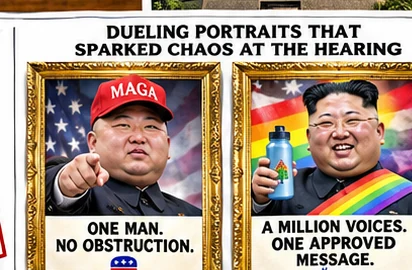
The representative objected, explaining that unauthorized depictions of Kim were forbidden.
Both parties withdrew their portraits and requested authority to approve depictions of themselves.
The representative asked whether the Capitol had a back door.
Staff explained that all exits were under review by a bipartisan security commission.
He requested political asylum in Canada.
At 5:47 p.m., the committee unanimously condemned authoritarianism and established a bipartisan working group to identify its most promising applications.
The freshman congressman’s dissent was entered into the record as a scheduling conflict.
Congress invited Kim Jong Un to address a joint session, attend a state dinner, and receive an award whose name would be determined after polling.
Kim declined, citing concerns about human rights abuses in Washington, D.C.
Congressional leaders denounced his refusal as an insult to American democracy.
They then voted unanimously to have him arrested.