In the beginning, there was nothing.
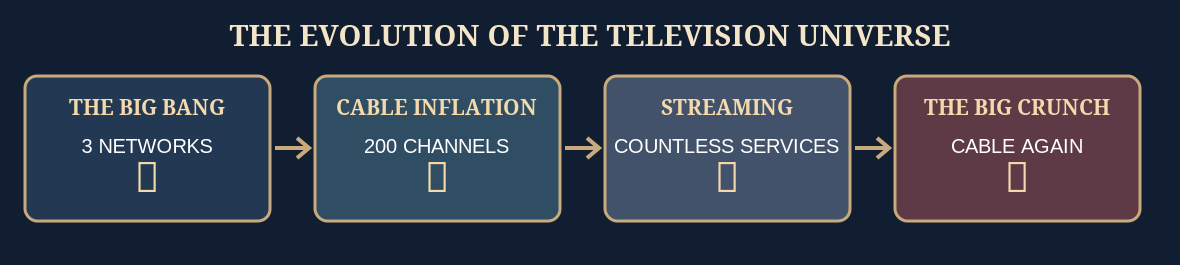
Then there were three television networks.
Then there was nothing on.
Scientists believe the universe began approximately 13.8 billion years ago. CBS maintains it was earlier, but we had the first season saved on our DVR and lost it when we got a new cable box.
For decades, the television universe remained relatively stable: ABC, CBS, NBC, and PBS, where British people solved murders and the Teletubbies had televisions installed in their stomachs.
We thought they were entertaining our children.
Turns out they were grooming them for a lifetime of screen addiction.
Television was free.
All you needed was a television, an antenna, and a father prepared to die on the roof so Don Johnson could arrest a drug dealer without wearing socks.
“Little to the left!”
That was how we spoke to the man holding the family together.
Sometimes the antenna wasn't enough, and we'd have to use one of the children as a transmitter.
“Stand over there. Hold this metal rod above your head.”
“Can I sit down?”
“Not until Miami Vice is over.”
We were a generation raised on secondhand smoke and electromagnetic radiation.
Our parents weren't concerned about screen time. They were concerned about screen reception.
Scientists now believe these children were the first human satellites.
Then cable arrived.
THE PERIOD OF RAPID INFLATION
Suddenly, three channels became 30. Then 60. Then 200.
It was just like cosmic inflation, except the universe didn’t make you stay home Thursday between eight and five.
Entire galaxies of programming appeared.
A channel for sports. A channel for weather. A channel for cooking food you would eat while watching the sports.
We had hundreds of channels and watched seven.
The others were there in case you woke up at 3 a.m. needing a commemorative coin or to cut your hair with a vacuum cleaner.
Cable companies began charging $3,790 a month.
You couldn’t buy just the channels you wanted. That wouldn't make any sense. You wanted the milk, you had to buy the whole farm.
You could get the sports package, the movie package, or the package where you called your father and asked what he was paying.
Somehow, he was paying $43.
He had all the channels.
He had negotiated this in 1996 with a woman named Denise.
THE STREAMING MULTIVERSE
Then Netflix appeared.
Eight dollars a month.
No commercials. No schedules. No cable box.
We reacted as though someone had liberated television.
The revolution arrived in a red envelope.
“We’re free!”
We said this to a laptop connected to the television by a cable we were not allowed to touch.
For the first time, you could watch whatever you wanted, whenever you wanted.
It turned out what I wanted was to look at the available movies until it was too late to start one.
Netflix would ask, “Are you still watching?”
Let’s not start assigning blame.
Soon, other services appeared.
Hulu. Amazon Prime. Disney+. Apple TV+. Peacock. Paramount+.
HBO Max became Max, then HBO Max again.
Even the name needed to be unplugged and plugged back in.
Each universe had its own programming and a password I couldn't reset because I'd forgotten my favorite 1970s dictator for the security question.
And somehow, the only movie you wanted to watch was always on the one streaming service you didn't have.
So now I'm paying another $24.99 to rent Breakin' 2: Electric Boogaloo on demand.
Eventually, we were paying $3,795 a month for services we couldn't remember subscribing to.
Canceling was considerably more complicated.
First, you had to travel to a remote monastery in Tibet, where a blind monk would instruct you to retrieve a rare flower that blooms once every 700 years.
You would then carry the flower barefoot across the Himalayas and present it to an elderly woman who had never seen a television.
THE GREAT CONTRACTION
Now scientists have observed something troubling.
The streaming universe appears to be contracting.
Services are merging. Prices are rising. Commercials are returning.
People are canceling subscriptions because they're tired of paying $3,795 a month for television.
This is especially concerning because the reason we invented streaming was that we were tired of paying $3,790 a month for television.
Streaming companies have responded by introducing bundles.
For one convenient monthly price, you can now subscribe to several services together.
You can even get live television.
And sports.
And commercials.
It's an extraordinary achievement.
We have spent 40 years, billions of dollars, and the combined intellectual resources of Silicon Valley developing a way to watch television exactly as we did in 1996.
Except now the remote needs charging.
Scientists call this the Big Crunch.
In cosmology, the Big Crunch is a hypothetical scenario in which the universe stops expanding and collapses back into a single point.
In television, that point is a Comcast customer service representative in Newark, New Jersey named Denise.
I believe we're approaching the final stage.
Eventually, every streaming service will merge into one enormous platform.
It will contain every movie and television show ever made.
There will be hundreds of channels.
You will pay one monthly bill.
You'll need a special box connected to your television, which a technician will install sometime between eight and five on a Thursday.
There will be three packages.
None will include the channel you want.
You'll call customer service to complain.
A woman will answer.
“Thank you for calling Comcast. This is Denise.”
“Denise? My father spoke to you in 1996.”
“Oh, yes. How is he?”
“He's fine. He's still paying $43.”
“Of course he is.”
“Can I get that rate?”
“No.”
And so, after four decades of technological innovation, humanity will have accomplished the impossible.
We will have invented cable television.
Again.
Scientists aren't certain whether the actual universe will end in a Big Crunch.
But they agree on one thing.
When it happens, somebody will have to be home between eight and five on Thursday.